When Precision Meets Pandemonium
Marina Volkov’s studio feels like a laboratory designed by a mad scientist who moonlights as a mathematician. Plastic sheets cover every surface, punctured with deliberate holes at precise intervals. Suspended above her workspace hang dozens of modified spray bottles, each filled with different viscosities of paint, positioned at calculated angles that would make a ballistics expert weep with envy. This is where controlled chaos becomes art, where Volkov has spent the last eight years perfecting what she calls “orchestrated accidents.”
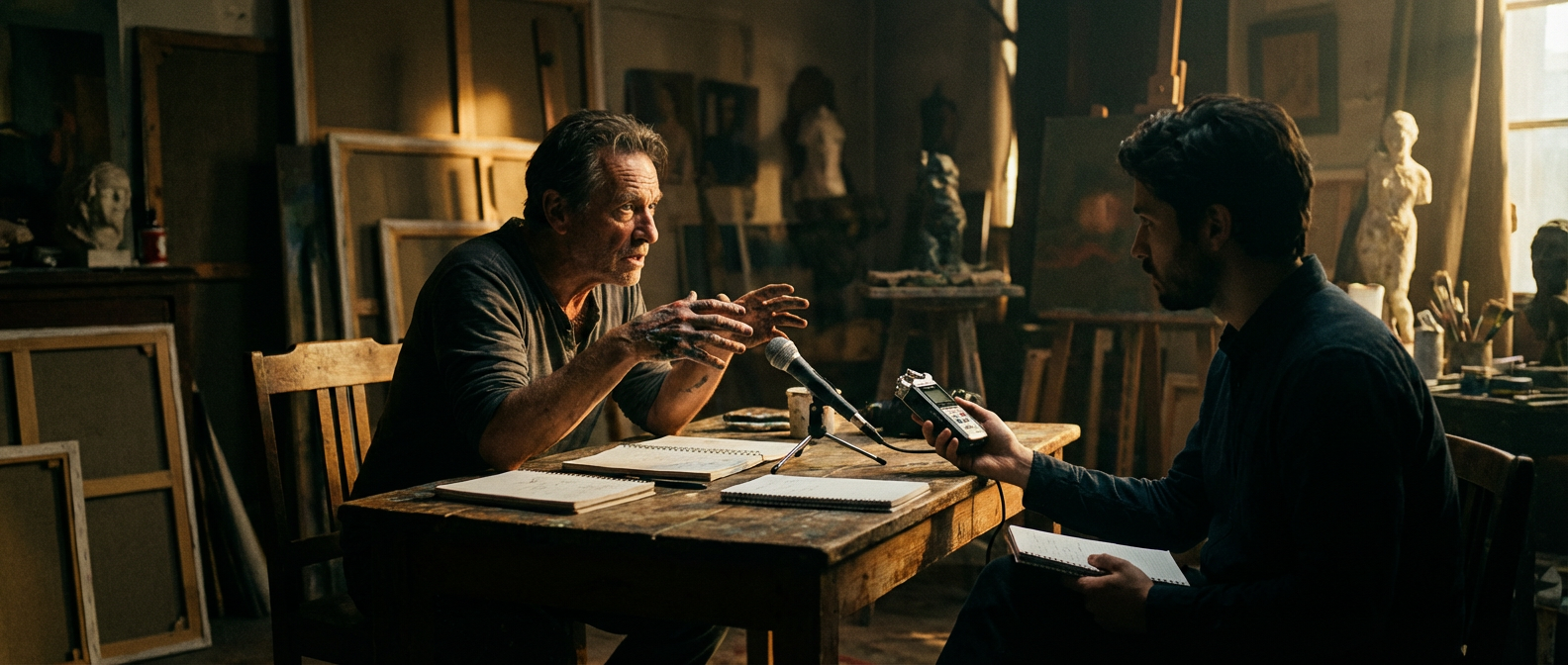
The Russian-born, Berlin-based painter has zero patience for romantic notions about spontaneous creation. “People see the drips and splatters and think it’s all intuitive gesture,” she explains while adjusting a motorized armature that rotates canvases at variable speeds. “But every ‘accident’ is the result of months of calculation. I’ve mapped the trajectory patterns of over 200 different paint consistencies. I know exactly where each drop will land before it leaves the bottle.”
This methodical approach to apparent randomness makes Volkov the spiritual heir to Jackson Pollock’s systematic experiments, but with a contemporary twist that would horrify action painting purists. Where Pollock trusted his body’s movement, Volkov trusts her machines. Where he sought to eliminate the conscious mind from mark-making, she programs consciousness into every mechanized gesture.
The Architecture of Unpredictability
Volkov’s process begins not with paint but with mathematical modeling software typically used by engineers. She inputs variables including canvas dimensions, ambient temperature, humidity levels, and the specific gravity of her custom paint mixtures. The resulting algorithms generate what she calls “probability maps” that predict the likely landing zones for each paint application. It’s a framework of calculated uncertainty.
Her paint recipes deserve their own scientific paper. Each color is mixed with varying amounts of silicone oils, alcohol, and proprietary additives that alter surface tension and drying time. “The yellow has 12% isopropyl alcohol and a stabilizer I borrowed from automotive paint technology,” she notes, pulling out a notebook filled with formulas that read like chemistry homework. “It creates cellular patterns when it hits the canvas that are impossible to achieve with traditional media.”
The actual painting happens in layers, each applied by different mechanical systems. First, a series of pendulums swing across the horizontal canvas, releasing controlled amounts of base colors. Then, rotating spray mechanisms add secondary hues while the canvas moves through predetermined positions. Finally, Volkov introduces what she calls “chaos agents,” compressed air bursts that disrupt still-wet paint in calculated intervals.
Beyond the Brushstroke: Rethinking Painter’s Tools
Traditional painting tools have no place in Volkov’s arsenal. She collaborates with a team of engineers to build custom applicators that would be equally at home in a manufacturing facility or a physics lab. Her latest invention is a device she calls the “vector sprayer,” a computer-controlled nozzle system that can apply paint at angles impossible for human hands while maintaining microscopic precision in droplet size.
The canvas preparation alone takes three days. Each surface receives multiple primer layers, with specific areas masked to control paint absorption rates. “I’m painting the painting before I paint the painting,” Volkov explains. “The canvas becomes a topographical map of planned interactions.” She documents every variable obsessively, creating detailed production notes that read like surgical procedures.
Her color mixing happens in temperature-controlled conditions, with each batch tested on sample surfaces before application. Paint consistency is measured with viscometers, and each mixture’s behavior is documented through slow-motion video analysis. This isn’t romantic artist intuition. This is industrial research and development applied to fine art production.
The Philosophy of Programmed Spontaneity
Critics often struggle with Volkov’s mechanical approach, viewing it as opposite to painting’s expressive tradition. She anticipated this resistance. “People want painters to be emotionally driven, romantically inspired,” she says while calibrating a pressure gauge. “But why should the source of creative input matter more than the quality of creative output? My machines are extensions of my artistic vision, just like Michelangelo’s chisels were extensions of his.”
The conceptual framework underlying her work draws from chaos theory and systems thinking rather than art historical precedents. Each painting explores the boundary between determinism and randomness, questioning whether true spontaneity can exist within structured parameters. “I’m interested in the moment when control breaks down,” she explains. “But I want to engineer that breakdown precisely.”
Her latest series, “Probability Studies,” pushes this investigation further. Each painting exists in multiple versions. The same initial parameters generate different outcomes through microscopic variations in environmental conditions. She’s essentially creating artistic experiments with built-in control groups, treating her studio like a research facility that happens to produce wall-worthy results.
Documentation as Secondary Creation
Perhaps most fascinating is Volkov’s documentation process. Every painting session is recorded from multiple angles using high-speed cameras. The resulting footage becomes source material for video installations that show the paintings’ creation in compressed time. “The process is as much the artwork as the final object,” she insists. “I’m making visible the usually invisible act of creation.”
Her studio walls display time-lapse sequences showing paint behavior under different conditions. These studies inform future work while functioning as artworks themselves. Gallery visitors often spend more time watching the process videos than examining the finished paintings, suggesting that Volkov’s true innovation lies in making artistic methodology itself a viewable medium.
The meticulous record-keeping has practical purposes too. Each painting comes with a complete “recipe” that theoretically allows for reproduction, though Volkov notes that environmental variables make exact duplication impossible. “It’s like cooking,” she explains. “I can give you my recipe, but your version will taste different because your kitchen isn’t identical to mine.”
Volkov’s systematic dismantling of painting’s romantic myths reveals new possibilities for artistic creation in an era of technological integration. Her work suggests that precision and spontaneity need not be opposing forces, that calculation can help inspiration rather than stifle it. Whether her approach represents painting’s future or an elaborate conceptual dead end remains an open question worth debating over dinner, preferably one where someone has the nerve to challenge received wisdom about what authentic artistic creation actually looks like.