The Final Breath of Artistic Purity
Fine art died somewhere between Andy Warhol’s first Campbell’s soup can and the moment Marina Abramović posed for a Lady Gaga music video. Not literally, of course, but the hermetically sealed world of high culture that once existed in pristine isolation from the masses finally gave in to the relentless push of popular media. What we’re seeing now isn’t corruption or decline, but the completion of a transformation that began the moment Walter Benjamin wrote about mechanical reproduction and hasn’t stopped since.
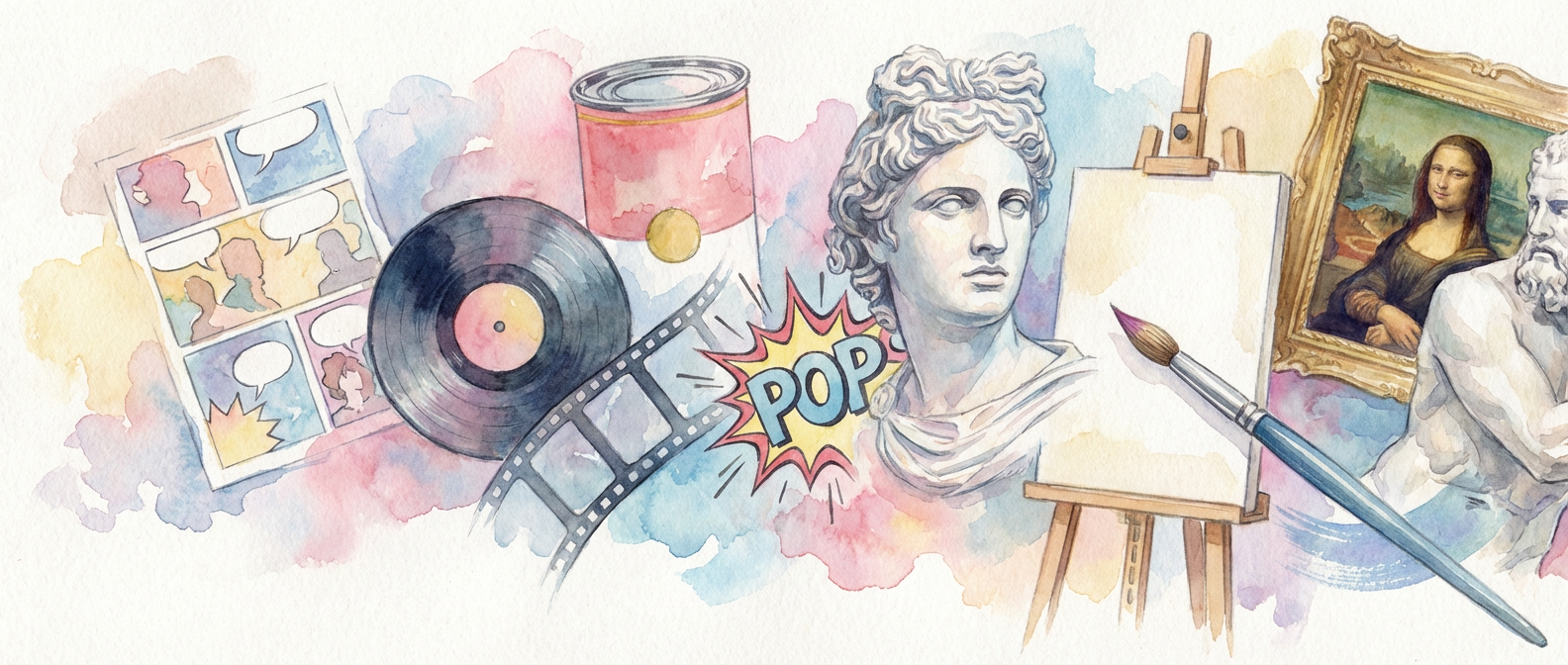
The old guard mourns this death like it’s a tragedy. Gallery owners still speak in hushed tones about “maintaining artistic integrity” while secretly counting Instagram likes on their latest exhibition posts. Critics complain about the “dumbing down” of discourse while writing 500-word reviews designed for social media consumption. But this nostalgia for an imagined golden age of pure artistic expression ignores a fundamental truth: the ivory tower was always a construction, and pop culture simply revealed its foundations were built on sand.
Look at the path from Jackson Pollock’s action paintings being dismissed as mere spectacle to Jeff Koons’ balloon animals selling for tens of millions. The critical establishment that once sneered at populist accessibility now scrambles to fit Instagram artists and TikTok aesthetics into established frameworks. The transformation isn’t just happening to art. It’s happening to the entire apparatus that surrounds and defines it.
The Great Contamination
When Takashi Murakami first brought his colorful flowers and anime-inspired characters into gallery spaces, purists recoiled as if he’d wheeled a carnival into a cathedral. Yet Murakami’s genius wasn’t just in bridging high and low culture. It was in exposing how artificial that distinction had always been. His collaboration with Louis Vuitton didn’t cheapen his gallery work. It revealed that exclusivity had been fine art’s primary commodity all along.
The contamination spread through weird channels. Street artists like Banksy forced the art world to deal with works that existed primarily through social media documentation rather than physical presence. Suddenly, a piece’s “aura” wasn’t tied to its material existence but to its viral potential. Museums found themselves competing with Netflix, video games, and whatever was trending on Twitter.
This shift went into overdrive during the pandemic, when virtual gallery tours and online exhibitions became necessity rather than novelty. The democratization of access that technology enabled also flattened the hierarchies that had long sustained fine art’s claim to cultural supremacy. A teenager in suburban Ohio could now engage with contemporary art as immediately and meaningfully as a collector in Chelsea, armed with the same digital tools and reference points.
The result wasn’t the apocalypse that traditionalists feared, but something far more interesting: a flowering of hybrid forms that couldn’t be easily categorized. Digital artists began showing in traditional galleries while classical painters found audiences through YouTube tutorials. The boundaries didn’t just blur. They became irrelevant.
Autopsy of an Elite
The anatomy of fine art’s death reveals fascinating details about what it actually was. Strip away the mystique, and you find an industry built on scarcity, exclusivity, and the careful management of cultural capital. Pop culture didn’t kill these mechanisms. It simply offered more efficient alternatives. Why spend years cultivating taste through education when algorithmic recommendations could deliver personalized aesthetic experiences instantly?
The old model depended on gatekeepers who controlled access to meaning. Critics, curators, and collectors formed a triumvirate that determined which works deserved attention and which artists merited careers. Pop culture dismantled this structure not through direct assault but through irrelevance. When millions of people could discover and discuss art without institutional mediation, the gatekeepers found themselves guarding empty gates.
Academic art theory, once the specialized language of initiated discourse, gave way to more immediate forms of critical engagement. The elaborate theoretical frameworks that surrounded conceptual art seemed overwrought compared to the direct emotional impact of a well-crafted meme or music video. Complexity wasn’t abandoned, but it was redistributed across new forms and platforms that didn’t require advanced degrees to decode.
The Unexpected Renaissance
What emerged from fine art’s death wasn’t cultural barbarism but an unexpected renaissance. Freed from the need to justify their practice through theoretical gymnastics, artists began exploring genuinely experimental territory. The pressure to appear serious and important lifted, replaced by opportunities to be genuinely innovative across multiple media simultaneously.
Musicians like Björk and Kanye West created immersive visual experiences that challenged traditional boundaries between concert and installation. Filmmakers like Jordan Peele embedded sophisticated social commentary within popular genre frameworks, reaching audiences that contemporary art had long since alienated. Video game designers crafted interactive narratives that achieved emotional depths previously associated only with elite literary fiction.
The cross-pollination worked in reverse as well. Gallery artists began incorporating elements of popular culture not as ironic commentary but as legitimate aesthetic material. The distinction between appropriation and appreciation collapsed as artists recognized that pop culture offered as rich a symbolic vocabulary as any historical tradition.
Museums adapted by embracing their role as cultural spaces rather than temples. Exhibitions began including video games, fashion, and design alongside traditional media. The Louvre’s collaboration with Fortnite wasn’t a betrayal of high culture but an acknowledgment that cultural significance now originated from multiple sources simultaneously.
Legacy Without Nostalgia
Fine art’s death created space for something more vital to emerge. The skills, traditions, and ways of seeing that defined centuries of artistic practice didn’t vanish. They spread throughout culture, enriching everything they touched. Technical mastery in drawing enhanced concept art for blockbuster films. Compositional principles from classical painting influenced music video direction. Color theory developed in abstract expressionism influenced user interface design.
This diffusion represents fine art’s true legacy: not the preservation of exclusive institutions but the democratization of sophisticated aesthetic thinking. When a teenager creates a TikTok video that demonstrates intuitive understanding of rhythm, color, and narrative structure, they’re applying principles that once required formal training to access. The education happened. It just occurred through different channels.
The most exciting contemporary artists understand this transformation and work within it rather than against it. They create across multiple platforms, engage directly with audiences, and refuse to apologize for accessibility. They’ve inherited the best aspects of fine art tradition while discarding the pretensions that had calcified around it.
Perhaps the real question isn’t whether pop culture killed fine art, but whether fine art was worth saving in its original form. The death we’re witnessing might be better understood as a metamorphosis, one that preserved everything essential while discarding everything that had become obstacles to genuine cultural engagement. What do you think: are we mourning a loss or celebrating a liberation?