Oldetownehalltheatre

Oldetownehalltheatre

Oldetownehalltheatre

Art, culture, and the conversations that matter.

Culture writing should be as honest and fearless as the work it examines. Our critics and contributors dig into music, visual art, film, and performance with real curiosity. We’re not here to rubber-stamp the obvious or play it safe.

Topics we cover: Visual Art · Music · Film & TV · Performance · Photography · Criticism

The Creative Surge: AI in the Arts Unleashes a New Renaissance

The Creative Surge: AI in the Arts Unleashes a New Renaissance

If someone told me five years ago that Artificial Intelligence would not only reshape how we code and process data but also how we conceive art, I probably would’ve shrugged it off. I mean, AI in the arts? You might as well tell me my Keurig was going to compel me to write love poetry! And yet, here we are, watching an AI-driven creative explosion that’s already changing how we think about art, music, and storytelling.

The AI Revolution: Not Just for Coders

When most people think of AI, their minds typically drift toward its implications in data science, development, and automation. But artists and creators worldwide are proving that AI isn’t just a tool for engineers and data scientists. We’re seeing artists team up with these algorithms to create things that were impossible before.

Take, for instance, OpenAI’s GPT models. Initially designed for language processing, they’re now being used to craft lyrics, short stories, and even co-write novels. Heck, if Hemingway were around today, he’d probably have a blast getting an AI to mess with his famously sparse prose.

But it doesn’t stop at text. Platforms like DeepArt and RunwayML use neural networks to analyze and copy the styles of famous painters, letting artists apply digital brushstrokes that mimic Van Gogh’s swirling stars or Picasso’s angular abstractions. Suddenly, every tech-savvy painter can channel the greats right from their desktop.

A Partnership: Humans & Machines

Now, you might be wondering, does this mean AI is replacing artists? Not quite. I’d argue that AI is becoming a new brush or pen in the creative toolkit. The relationship feels more like a partnership, with human creativity driving the process and AI providing a new way to express it.

Take music, for example. There’s already a wild mix of AI-composed tunes popping up on platforms like Spotify. Some are entirely machine-generated, while others come from collaborations between humans and AI. Artists like Taryn Southern have hit it big with tracks that feature AI-generated melodies, harmonies, and even lyrics. Far from overshadowing human creativity, AI seems to boost it, pushing artists to explore new territory.

And it’s not just musicians. Animators, game developers, and filmmakers are using AI to design landscapes, generate realistic animations, and even plot out entire narratives. Imagine a future Pixar blockbuster aided by AI storyboarding or character modeling. The thought both excites and terrifies me, but in a good way, the kind of fear that comes with stepping into the unknown.

Challenges & Ethical Questions: Figuring This Out

Of course, it wouldn’t be a tech revolution without its messy complications. As AI gets deeper into the arts, questions of copyright, authenticity, and authorship pop up everywhere. Who owns a piece of music if a machine was the composer? Can an algorithm have a style, and if so, can it be protected by intellectual property laws?

It’s a bit like arguing about the authenticity of a Banksy. Who cares? The point is, it exists, it challenges what we expect, and most importantly, it gets us thinking. As we figure out these new rules, society will have to decide what’s fair for both artists and the machines they work with.

And then there’s the real worry about quality. Let’s face it, not everything AI produces is brilliant. Sometimes it’s downright weird or unintentionally hilarious. I stumbled upon an AI-generated sonnet that left me wondering if it was trying to channel Shakespeare or Dr. Seuss. But hey, art is subjective, right?

Looking Ahead: What the Arts Might Look Like in 2030

So, what’s next? Looking towards 2030, I picture a world where AI’s role in the arts is as common as social media is today. Virtual reality galleries filled with AI-crafted sculptures, immersive storytelling experiences powered by AI-generated plots, or even completely new genres of music born from algorithmic experimentation. It’s not just about making creativity more accessible. It’s about pushing the boundaries of what’s possible.

With AI as a creative partner, we might see budding artists who’d never set foot in a studio, or those who felt limited by their own technical skills, suddenly able to create more freely. This technology is changing the game, offering tools, inspiration, and support to everyone, from the backyard guitarist to the experimental filmmaker.

In this AI era, expect the unexpected. Sure, it’ll spark discussions, debates, maybe some cries of “This isn’t art!” But if history has taught us anything, it’s that every artistic breakthrough eventually finds its place. So let’s embrace the weirdness, laugh when it gets silly, and be amazed by the masterpieces it helps us create together.

Who knows, maybe there’s an AI out there right now, using me as its inspiration, planning its own blog to write about the quirks of working with humans. Now, wouldn’t that be something?

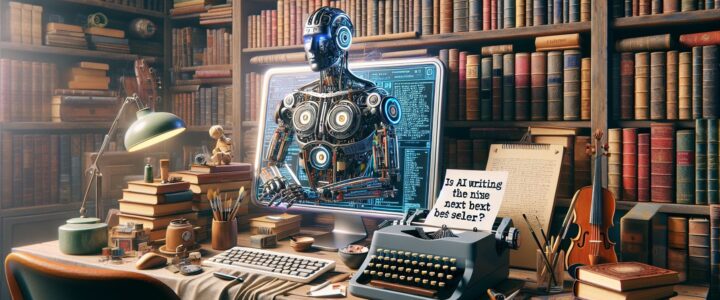
Is AI Writing the Next Best Seller? The Surprising Symbiosis of AI and Creative Arts

Is AI Writing the Next Best Seller? The Surprising Symbiosis of AI and Creative Arts

Hey tech enthusiasts! Today we’re diving into one of the hottest and definitely one of the most interesting intersections of technology and human expression: AI in creative arts. Grabbing your popcorn yet? If not, you totally should! This is the sci-fi movie plot that’s fast becoming real life, and trust me, you’ll want a front-row seat.

From generating realistic human-like art to crafting compelling narratives, AI is throwing some serious paint onto the canvas of the creative arts. As a fellow earthling who geeks out over both machine learning and storytelling, I’m buzzing with excitement (and coffee) as I write this. So let’s dig in, shall we?

Art: Not Just a Thing of the Past Anymore

Once upon a time, art was reserved for the Picassos and the Van Goghs of the world. Fast forward to today, and you have artificial intelligence holding a paintbrush, well, metaphorically speaking. We’ve all heard of DeepDream and its psychedelic imagery. A trippy swirl of colors that made everyone wonder if Google’s servers had been sneakily participating in Burning Man.

The Brushstrokes of Algorithms

Let’s talk about the magic behind the curtain. Techniques like GANs (Generative Adversarial Networks) create artworks that compete at auctions and sometimes even masquerade as human-made art. One of the granddaddies of this wonder, Ian Goodfellow, invented GANs hoping to boost machine learning’s generative capabilities. Imagine his surprise when his brainchild started making art with echoes of the masters. This is the stuff of tech romances, if you ask me.

Human Meet Machine: The Art Collaboration

What’s absolutely mind-blowing to me is not just that AI can create art but the way it’s intertwining with human creativity. Artists and AI are forming a collaboration born from mutual curiosity. They’re co-creators, shifting paradigms of what’s possible in art. Renowned AI artist Mario Klingemann often describes his work with AI as a kind of duet, each entity informing and transforming the other. Creativity isn’t disappearing. It’s exponentially expanding!

Pen and Processor: The Future Shakespeare?

Onward to my personal favorite: writing. Now, I know what you’re thinking: “How in the tech universe can cold algorithms write heartfelt novels?” But here’s the kicker: AI doesn’t just write, it writes well, sometimes even better than that barista-poet wannabe at your local coffee shop (no shade).

Wordsmiths of the Silicon Valley

Is the New York Times Bestsellers list shaking in its boots? Well, not quite yet, but ride along as I take you on a quick tale of GPT models. OpenAI’s GPT-3 turned tables when it managed to fool seasoned writers and readers in a Turing test-like scenario with its uncannily human prose. It rivals some of the stanzas churned out by, dare I say it, students pulling all-nighters. Though it hasn’t penned the next “Great American Novel” yet, as a tool, it helps with those dreaded bouts of writer’s block.

The Academy of AI Authors

Imaginations are on fire with the potential applications here. Writers like Margaret Atwood have mentioned the allure of artificial intelligence as collaborative tool rather than threat. Poets and novelists are beginning to use AI to harness rhythm and structure for unprecedented experimentation. And all of a sudden, writing becomes a dance, not with wolves, but with circuits and syntax.

A New Renaissance or Just a Retrograde?

Before you scrape the paint off your bedroom walls or surrender your pens to your algorithms, let’s take a breather and think about the implications. We’re talking about an entire landscape redefined by technology that was purely theoretical a few years ago.

Challenges and Concerns

No conversation about AI in creative arts is complete without addressing the elephant in the room: authenticity and originality. Will AI outshine originality? Will the next Gen-Z Picasso be a bunch of wires and chips? These are pressing concerns and, true, the art world loves a good crisis. The challenge is making sure the technology remains a tool for enhancing human creativity, not replacing it.

Dreaming Ahead: The Infinite Canvas

We might be at the cusp of a new Renaissance, not bound by time and space but made in silicon and imagination. Our future could see AI not as a replacement for artists and writers but as a profoundly inspirational collaborator, sparking fires of creativity we never thought possible.

Before You Unplug…

As we welcome our synthetic symbiotes into this dreamscape, one thing remains important: the human spirit in art isn’t merely an ingredient. It’s the main dish. So let’s continue to create together, embracing our digital dance partners while holding on to what makes us human.

Grab your pen, your brush, or your keyboard, and go create the next masterpiece, with maybe a little help from our new AI pals. And who knows? Maybe the next world-changing piece of art or literature is just a few emails and algorithms away.

Looking forward to your thoughts and reactions in the comments below. Can’t wait to hear what you plan to do with your own AI-enhanced creativity!

Breakthrough in Longevity: Unraveling the Secrets to Immortal Health

Breakthrough in Longevity: Unraveling the Secrets to Immortal Health

Hey there, tech enthusiasts and curious minds! Buckle up—today, we’re diving into a topic that’s as intriguing as it is controversial: the latest advances in longevity. Now, before you dismiss this as another science fiction tale, hear me out. We might actually be on the verge of cracking the code to living longer, healthier lives. Who’d have thought your morning coffee might soon just be a sip in your centuries-long journey? Let’s explore!

The Great Quest for Longevity

We’ve always had a bit of a fascination—okay, maybe an obsession—with living forever. Ancient alchemists sought the mythical elixir of life, while explorers searched for fountains of youth. Fast forward to today, our version involves a lot more labs and a lot fewer magical concoctions.

A couple of weeks ago, I stumbled upon a study from our friends at the SENS Research Foundation, and it’s quite the eye-opener. The scientists there are working on “senescence,” which, in layman’s terms, is the process where our cells effectively throw in the towel and contribute to aging. They’ve made progress in gluing together fragmented DNA and fixing cellular damage. While this might sound a little Frankenstein-ish, it’s actually part of a broader movement in scientific circles to shift from treating diseases to preventing the aging process itself.

CRISPR: Nature’s Scalpel

Now, if there’s a hero in the longevity saga, it’s got to be CRISPR. These molecular scissors have been snipping out genetic boo-boos left, right, and center. Imagine identifying a rogue gene that kicks off the aging process and then simply editing it out. It’s like finding out that the bad plot twist in your favorite TV show was just a clerical error, and then erasing it from existence.

Scientists are using CRISPR to study age-related diseases from Alzheimer’s to heart conditions, with the ambitious aim of preventing or reversing them altogether. And let’s be honest, if CRISPR can keep my mind intact long enough to remember all my passwords without hitting “Forgot?” I’m all in.

A New Frontier: The Gut Microbiome

Next on our journey to eternal youth is the unlikely hero of our guts. No, I’m not talking about a new superhero duo. The microbiome—those super tiny organisms making a home in our intestines—has serious potential for extending our health span.

Recent studies show our gut flora as the gatekeepers of longevity. By managing inflammation and influencing everything from mood to metabolism, a healthy microbiome could be the key to keeping us spry. Some companies are even working on personalized dietary recommendations and microbiome transplants (fancy term for gut makeovers!). It’s like hosting the Olympic Games in your intestines—may the best bacteria win.

The Role of AI in the Quest for Longevity

Of course, it wouldn’t be a techno-utopian piece without mentioning Artificial Intelligence. From discovering new drugs to predicting one’s biological age with precision, AI is speeding up our journey to age reversal like nobody’s business. Take a moment to imagine your friendly neighborhood AI predicting how small changes, like skipping that extra donut or running five miles, could tack on three more years to your life. Freaky, right?

There are companies, such as DeepMind and Insilico Medicine, that are using AI algorithms to better understand how aging works. The future could see us appointing virtual health advisors that chart out personalized week-by-week life strategies (kind of like fitness trackers, but with a side of existential crisis).

Ethical Considerations and the Quest for Equity

Now, with all these exciting tidbits, we need to keep our feet on the ground and ask ourselves some hard questions. Who gets access to this tech? Will it widen the existing social divides if only the mega-rich can afford to live extra-long lives? It’s a tricky web to untangle, but given our track record as a society, we’d better start weaving solutions sooner rather than later.

Efforts across the globe focus on ensuring equitable access—because longevity isn’t just about living longer, but living better for everyone. As much as I enjoy sci-fi, I really don’t want a world where only billionaires enjoy the privilege of extended lifespans while the rest of us stick to the regular old timeline.

What’s Next? The Future of Human Health

In short, the way we approach aging and health is changing fundamentally. While eternal youth might be a stretch, the idea of living without the typical old-age woes and for a good longer stretch isn’t far-fetched at all. Whether it’s CRISPR, AI, or a perfect cocktail of probiotics, our future selves might thank us for the progress we’re making today.

In 10 to 20 years, who knows what natural boundaries we’ll have crossed? Personally, I’m excited about the concept of becoming an old, wise… uhm, elder—that’s code for still being able to keep a check on the latest tech—without the struggles we typically associate with aging. More time to bug the younger generation, more time to achieve lifelong dreams—you get the drift.

So that’s my scoop for today. What do you think? Are we on the cusp of a world where we sip cocktails well into our 150s, or are we opening Pandora’s flask? Drop your thoughts, hop on this bandwagon with me, and let’s navigate these exciting times together! 🍸📅

Riding the Pixel Wave: AI in the World of Creative Arts

Riding the Pixel Wave: AI in the World of Creative Arts

Hey fellow tech aficionados! Today, I want to talk about something that’s been on my mind lately: artificial intelligence in the world of creative arts. It’s the kind of marriage that seems straight out of a sci-fi movie but is happening right now in our reality. And I mean, when I say it’s everywhere, think about everything from deep neural networks creating incredible artwork to algorithm-driven melodies that actually make you groove. Let’s explore why this growing romance between AI and creativity is turning heads and occasionally blowing minds.

Artists and Algorithms: A Dynamic Duo

In case you’ve been under a rock—or simply blissfully offline—let me catch you up: AI is becoming quite the creative force. I’m not just talking about generating pop songs or digital art; we’re talking full-on creative collaboration. One notable player in this field is OpenAI, whose models have been working on everything from writing novels to composing symphonies. But it’s not just OpenAI. Players big and small are getting into the game, changing what we consider the realm of human-only creativity.

The Dance of Creativity

The real charm here is how AI systems don’t replace humans. They amplify what we do. You can think of it as choreographing a dance where both parties bring something unique to the stage. Digital artists are using AI to produce pieces that would take months to envision and create manually. The algorithms provide a fresh burst of creativity, producing designs and ideas that challenge our senses and conventions.

Take AI-generated art sold at high-end auctions for thousands of dollars. One might argue the buyer’s purchasing tech wizardry, yet isn’t all art a form of medium, be it oil paint or pixels? And here’s a fun twist—these AI models often produce art that remains open to interpretation, much like traditional pieces. So in a sense, they’re engaging us in the same cerebral dance as conventional works.

The Sound of Future: AI Music Composition

Open your mind and ears, because the concert of the future is already in session! Platforms like Amper Music and Jukedeck are allowing artists to create rich soundscapes with AI assistance. You could argue that it’s easier to get into music production now than ever, whether you’re a professional musician looking to expand your repertoire or a closet DJ just wanting to impress (or annoy) your neighbors.

When AI Channels Beethoven or Bono

AI-generated music doesn’t just stick to one genre either. Whether you’re into classical symphonies a la Beethoven or something more electro-pop that pumps like Bono’s energy, AI gets there. The kicker here is the adaptability and personalization AI brings into the music production process. Algorithms learn and adjust to the preferences of the human collaborator, promising something fresh every single time.

And let’s not forget the fun aspect—AI can churn out tunes faster than you can say “Grammy.” It’s like having a jam session but your band members are neural networks that never get tired or need a snack break. Okay, that might actually be a downside, but you get the idea.

Challenges: Creativity Versus Calculations

Hold your horses though! Before we get whisked away into this techno-utopian whirlwind, it’s worth acknowledging the speed bumps on this highway to creativity. AI in creative arts is still in a teething phase, hitting practical, ethical, and philosophical hurdles.

Whose Art Is It Anyway?

One tantalizing challenge is authorship. When AI creates something beautiful, who does it belong to? The artist? The coder? The company that made the AI? Legal systems worldwide are playing catch-up, sparking debates centered on intellectual property rights that could rival the great art debates of yesteryear.

These questions aren’t just bureaucratic nitpicks. They touch on what it means to be creative, to be human even. And while it may take years for legal clarity to emerge, these are fascinating questions ripe for debate, not just amongst nerds at hackathons, but boardroom executives and artists alike.

Peeking into Tomorrow: What’s Next for AI and Creativity?

Looking ahead, the horizon is packed with possibilities. If you thought what we’ve done so far was impressive, brace yourself for what’s in the pipeline. Imagine not merely consuming entertainment created by AI, but interacting with narratives that adjust in response to your emotional state, curated by sensors embedded into literally everything.

Artisanal Algorithms

On the upside, we’re venturing into creative terrains similar to those of a bespoke craftsman in a digital workshop. Modular AI systems might allow artists to select specific components for projects like they might choose a brush or a musical instrument. It’s as if each artist gets to help build the very AI that collaborates with them—an artisanal algorithm, if you will.

Real talk though, as we embrace and explore the partnership between AI and creativity, we might just end up redefining what it means to be an artist, all while pushing the boundaries of both technology and human imagination.

In the end, AI is here to stay in the creative realm, and it’s not about competition but collaboration. I, for one, am excited to see where this leads. Let’s just hope the robots don’t get too good at karaoke, it might be embarrassing for the rest of us!

As always, keep your feet on the ground but your head in the cloud (and your data securely backed up in the process). Until next time, let’s keep dreaming up and coding futures that maybe we can all sing along to someday.