Why Every Artist Is a Detective Story Waiting to Be Solved
Walk into any contemporary gallery and you’ll witness a crime scene of sorts. Not theft, but influence. That striking installation borrowing Kapoor’s void-black surfaces. Those photographs echoing Cindy Sherman’s staged artifice. The sculpture channeling Brâncuși’s elemental forms. Every artwork carries genetic material from its predecessors, and learning to identify these threads transforms passive viewing into active investigation.
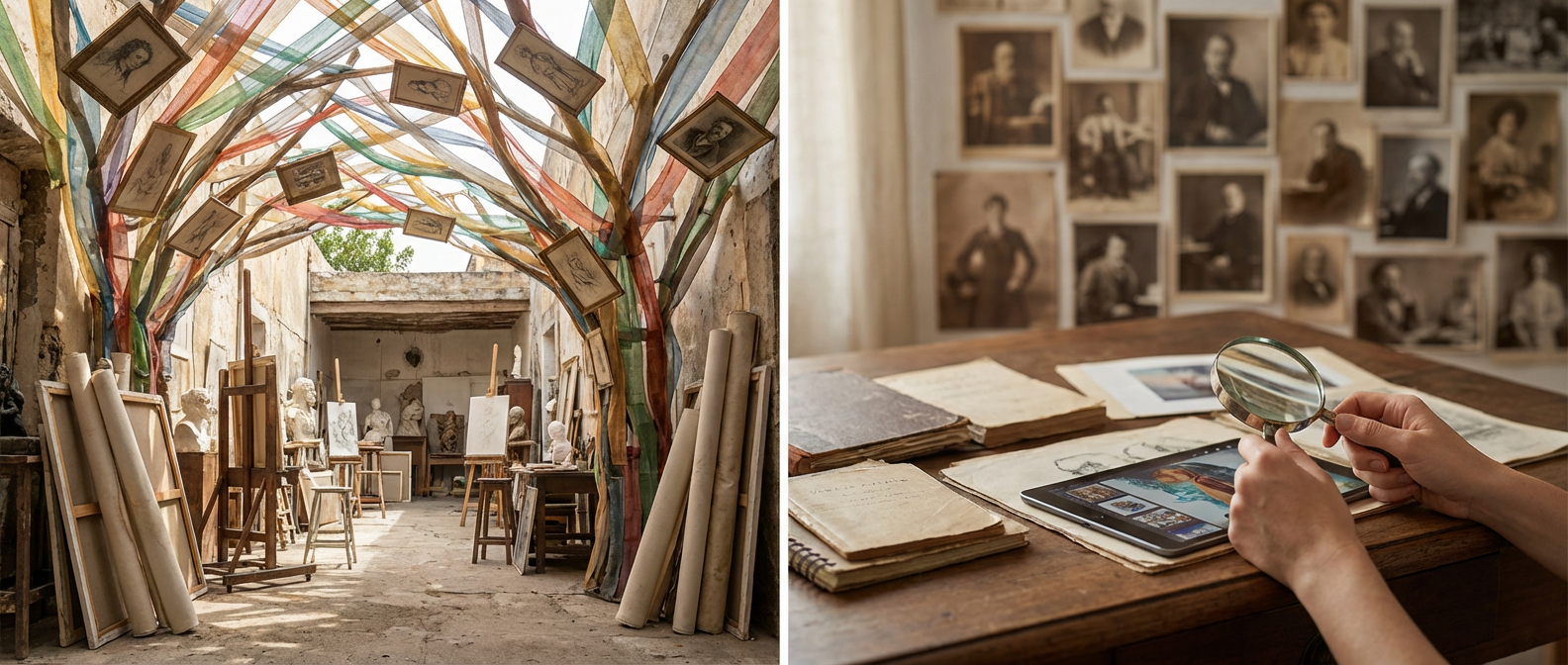
Understanding artistic lineage isn’t academic busywork. It’s the difference between hearing a song and understanding why it makes your spine tingle. When you recognize how Radiohead’s “Everything In Its Right Place” descends from Krautrock’s hypnotic repetition, or how Jordan Peele’s horror syntax draws from both Hitchcock’s psychological manipulation and blaxploitation’s social commentary, you’re not just consuming art. You’re participating in a centuries-long conversation.
Think of influence tracing as archaeology. You’re excavating layers of inspiration, technique, and rebellion. Sometimes the connections are obvious: David Lynch’s debt to surrealist cinema, or how every indie folk revival echoes Joni Mitchell’s confessional intimacy. Other times, the links surprise. Did you know that the stark minimalism of Agnes Martin’s grids shares philosophical DNA with John Cage’s chance operations? Or that hip-hop sampling culture fundamentally changed how all musicians approach composition?

The Art of Looking Backward: Where to Start Your Investigation
Begin with what moves you. That photographer whose work stops you mid-scroll. That filmmaker whose movies feel like fever dreams. That musician who seems to channel sounds from another dimension. Don’t start with art history textbooks. Start with curiosity about the art that already lives in your bones.
Google becomes your first archaeological tool, but use it strategically. Search “[artist name] influences” or “[artist name] inspired by.” Read interviews where creators discuss their heroes. Watch documentaries. Criterion Channel and MasterClass are goldmines for hearing artists explain their own genealogies. When Spike Lee discusses Akira Kurosawa, or when Björk references everything from Stockhausen to traditional Icelandic music, they’re handing you a roadmap.
Pay attention to the specific vocabulary artists use when describing their influences. When someone mentions “the Canterbury Scene,” they’re pointing toward a specific late-60s British progressive music movement. When a filmmaker references “Italian neorealism,” they’re invoking post-war cinema’s documentary-style approach to human stories. These aren’t pretentious name-drops. They’re breadcrumbs leading to entire artistic ecosystems.
Museums and galleries often provide the most accessible entry points into influence networks. Wall texts frequently mention connections between works, and many institutions now offer digital collections with robust cross-referencing. The Museum of Modern Art’s online collection lets you rabbit-hole through artistic movements with surgical precision.
Reading the Genetic Code: Techniques, Themes, and Transformations
Once you’ve identified potential influences, learn to read the visual and auditory DNA. This means developing fluency in the formal elements that get passed between artists like genetic markers. Color palettes. Compositional structures. Rhythmic patterns. Narrative techniques. The way light behaves in Caravaggio’s paintings directly influenced how Martin Scorsese lights his films, creating that dramatic interplay between shadow and revelation.
Influence rarely means direct copying. More often, it’s about artists solving similar problems or exploring parallel obsessions across different mediums and eras. Consider how Piet Mondrian’s grid abstractions and Steve Reich’s phase-shifting compositions both investigate mathematical repetition as spiritual practice. Or how the emotional rawness of Egon Schiele’s self-portraits and Kurt Cobain’s vocals channel similar veins of psychological exposure.
Look for technical innovations that ripple across disciplines. The cut-up technique that William Burroughs pioneered in literature influenced David Bowie’s lyric writing, which in turn shaped how countless musicians approach non-linear songcraft. Andy Warhol’s silkscreen process borrowed from commercial printing to comment on mass production, inspiring artists across mediums to embrace mechanical reproduction as aesthetic strategy.
Sometimes influence is deliberate rebellion. The French New Wave filmmakers explicitly rejected Hollywood’s polished studio system, but their rebellion was informed by deep knowledge of what they were rejecting. Understanding both the tradition and its disruption gives you complete picture of an artistic moment’s meaning.
Building Your Personal Influence Map: Making Connections Stick
Create your own influence ecosystem. Start a document, notebook, or digital board where you track connections between artists you love. When you discover that Alice Coltrane’s spiritual jazz influenced Flying Lotus’s electronic productions, or that Kerry James Marshall’s paintings dialogue with both Renaissance masters and Marvel comics, write it down. These connections compound over time.
Follow the money and institutions that shaped artistic careers. The same patrons, galleries, record labels, and film studios often share similar aesthetic approaches. Factory Records didn’t just release Joy Division and New Order. They developed a visual and sonic identity that influenced alternative music culture for decades. Understanding these institutional networks helps you trace influence beyond individual artist relationships.
Pay attention to geography and timing. Artistic movements often emerge from specific places during particular cultural moments. The Bauhaus school’s design philosophy, Detroit techno’s industrial soundscapes, the Los Angeles Light and Space movement’s environmental installations. These weren’t accidents of individual genius but products of artistic communities responding to shared circumstances.
Don’t ignore the role of technology in shaping artistic lineage. The electric guitar transformed blues into rock. Digital sampling created hip-hop. Video editing software democratized experimental film. Understanding how technical innovations enable new forms of expression helps you recognize why certain artistic developments happened when and where they did.
The Living Conversation: How Influence Continues to Evolve
Artistic influence isn’t museum prehistory. It’s happening right now. Today’s artists are simultaneously drawing from centuries of tradition and creating tomorrow’s influence networks. When you see a young painter combining traditional portraiture with digital glitch aesthetics, or a musician blending trap beats with chamber music arrangements, you’re witnessing influence in real time.
Social media has accelerated and democratized influence transmission. Artists can discover obscure inspirations instantly and share their findings globally. This creates more complex, non-linear influence networks than previous generations experienced. A bedroom producer in São Paulo might sample a 1970s Turkish folk record, add contemporary trap elements, and influence artists in Seoul and Stockholm simultaneously.
The best part about understanding artistic lineage is recognizing that every ending is a beginning. Once you can trace how your favorite artists connect to broader cultural conversations, you develop intuition for discovering new work that extends those conversations in unexpected directions. You become an active participant in the ongoing evolution of human creative expression.
Ready to start your own influence archaeology project? Pick one artist whose work genuinely excites you and spend this weekend following their creative DNA backwards through time. See where the rabbit holes lead. Then come back and let’s compare notes, because the best discoveries about artistic influence happen when passionate people share what they’ve found in the excavation.