The Canvas That Knows Your Heartbeat
I’m standing three feet from Yuki Tanaka’s “Emotional Landscape #3,” watching azure blues melt into volcanic oranges as my pulse quickens. The painting reads me like a mood ring on steroids, its thermochromic pigments responding to biometric data streaming from sensors embedded in the gallery floor and ceiling. This isn’t some Silicon Valley fever dream. This is February 2026, and the Los Angeles County Museum of Art has just cracked the code on something the art world has been chasing since the Romantics first proclaimed that great art should move us.

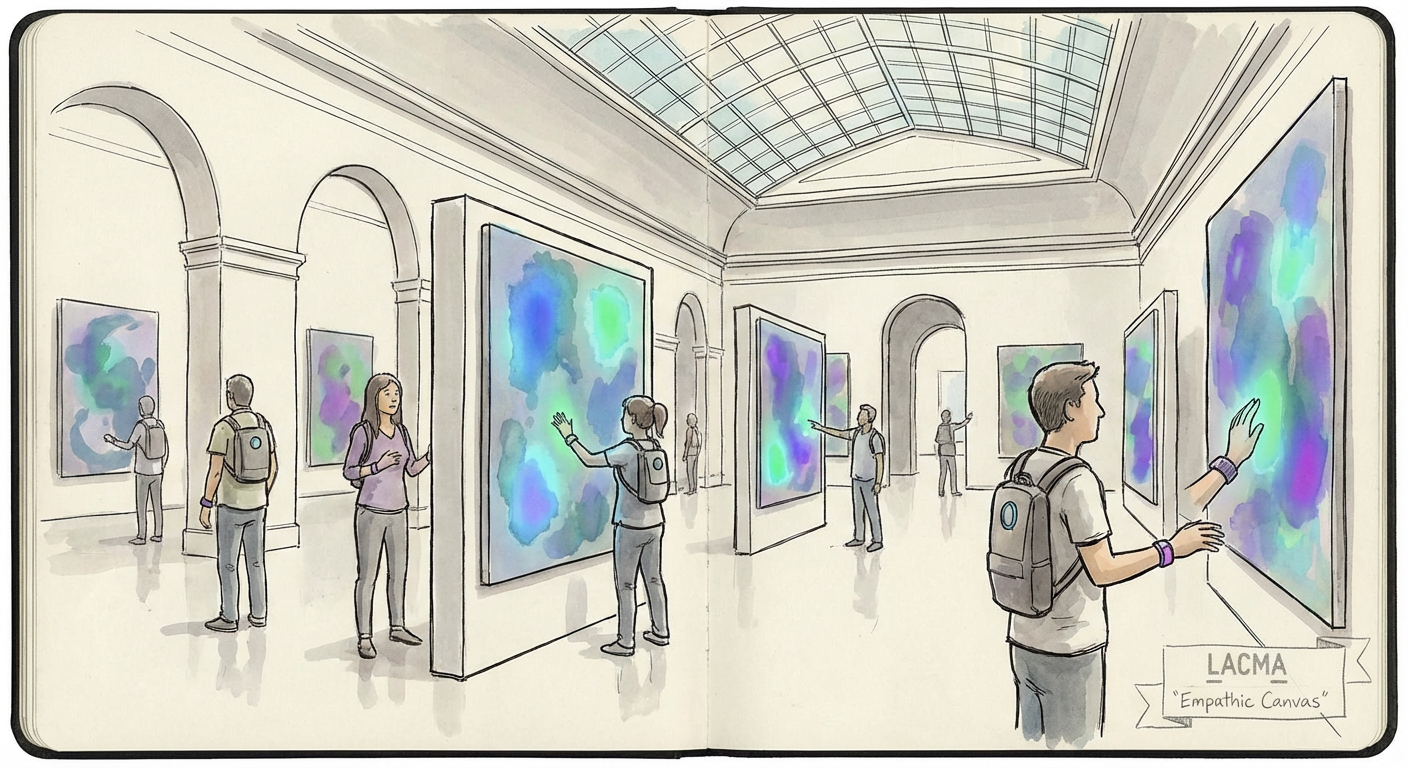
The LACMA Empathic Canvas Exhibition is a three-point-four-million-dollar gamble that traditional museums are failing their audiences. Twelve paintings embedded with thermochromic and electrochromic materials now shift and pulse in real-time response to visitors’ heart rates, skin conductance, and facial micro-expressions. It’s the kind of radical departure that would have sent Allan Kaprow into raptures and probably given Clement Greenberg an aneurysm.
But here’s what the critics missing the opening are failing to grasp: this isn’t a gimmick. It’s a complete reimagining of the relationship between artwork and audience that makes Marcel Duchamp’s urinal look quaint by comparison.
The MIT Connection: Where Neuroscience Meets Brushstrokes
The technology behind these responsive canvases comes from MIT Media Lab Biometric Art Research, where computer scientists and cognitive researchers spent three years developing sensors sensitive enough to detect the micro-fluctuations in human emotional states. We’re talking about technology that can read the subtle electrical changes in your skin, track the barely perceptible shifts in your facial muscles, and translate that data into color algorithms faster than you can consciously process what you’re feeling.
The sensors themselves are invisible, integrated into the gallery’s architecture with the same attention to aesthetics that LACMA brings to its lighting design. Visitors walk through electromagnetic fields that monitor their biometric signatures without any wearable devices or intrusive procedures. The paintings receive this data and translate it through proprietary software that maps emotional responses to specific color palettes and intensities.
What’s remarkable is how the technology preserves artistic intentionality while expanding it. Tanaka and the other featured artists spent months programming their pieces’ response patterns, creating what amounts to emotional sheet music that plays differently for every visitor. It’s collaborative art in the most literal sense, with each viewing creating a unique performance that will never be repeated exactly.
The Engagement Revolution: Why Eight Minutes Matters
The numbers tell a story that should terrify and exhilarate every museum director in the world. Visitor surveys reveal that ninety-four percent of people engage meaningfully with the Empathic Canvas pieces, compared to twenty-three percent for traditional static exhibitions. More telling, average viewing time has exploded from forty-three seconds to eight-point-seven minutes per piece.
But duration isn’t the real victory here. It’s the quality of attention these works demand. I watched a teenager spend twenty minutes with Tanaka’s piece, unconsciously modulating her breathing as she discovered how her emotional state affects the color temperature. She’s not just looking at art. She’s having a conversation with it, learning about her own emotional responses through the painting’s feedback loop.
This is what happens when museums stop treating visitors as passive consumers and start recognizing them as active participants in the aesthetic experience. The Empathic Canvas pieces don’t just hang on the wall waiting to be appreciated. They perform, they respond, they create moments of genuine surprise that force viewers to confront their own emotional reactions in real-time.
Tanaka’s Masterpiece: Forty-Seven Thousand Shades of Human
Tanaka’s “Emotional Landscape #3” has become the exhibition’s breakout star, recording forty-seven thousand distinct color variations during its first week on display. Each configuration is a unique emotional fingerprint, a visual record of how different visitors process the same visual stimuli. The piece basically creates a living archive of human emotional response, more comprehensive than any psychological study.
What fascinates me is how Tanaka has managed to maintain artistic coherence while embracing infinite variability. The painting’s base composition remains constant, but its emotional topography shifts like weather patterns across a landscape. Sometimes it pulses with nervous energy, electric greens and sharp yellows crackling across the surface. Other times it settles into deep contemplative purples and blues that seem to slow time itself.
The work succeeds because Tanaka understands that technology should amplify artistic vision, not replace it. The biometric responses trigger changes within carefully orchestrated parameters that preserve the piece’s aesthetic identity while allowing for genuine surprise and discovery.
The Global Ripple Effect: Beyond LACMA’s Walls
Fifteen international museums have already licensed the technology, generating over eighteen million dollars in revenue for LACMA’s education programs. But the real impact extends far beyond financial returns. We’re watching the birth of an entirely new medium, one that could completely alter how we think about the relationship between art and audience.
The implications reach into questions that have plagued aesthetic theory for centuries. If a painting changes based on who’s looking at it, where does the artwork end and the viewer begin? Are we looking at twelve paintings in the Empathic Canvas exhibition, or thousands of unique collaborative performances? These aren’t just theoretical puzzles for graduate seminars. They’re practical questions that will shape how the next generation experiences and creates art.
Museums that ignore this shift do so at their own risk. The traditional white cube model, with its emphasis on contemplative distance and reverential silence, suddenly looks as outdated as a daguerreotype. The future belongs to institutions willing to transform their visitors from observers into participants, from consumers into collaborators.
Visit the exhibition yourself and tell me what colors your emotions paint. I guarantee you’ll never look at a static canvas the same way again.